



Most universal TV remote apps cannot control multiple TVs at the same time — but they can switch between them quickly and easily. The key difference is simultaneous versus sequential control: one app, multiple TVs, but you manage them one at a time rather than sending commands to all of them at once. Below, we unpack how these apps work, what their limits are, and which setup actually makes sense for your home.
How do universal TV remote apps actually work?
A universal TV remote app works by connecting your smartphone or tablet to your TV over your home Wi-Fi network. Once both devices are on the same network, the app communicates with your TV using standard protocols like IR (infrared), Wi-Fi, or Bluetooth, depending on what your TV supports. No extra hardware or setup codes are required for most modern smart TVs.
When you tap a button in the app, your phone sends a signal across the network to your TV, just like a physical remote would. The app replicates the full remote control experience, including volume, channel switching, source selection, and mute, but with the added convenience of a touchpad and keyboard built right into your screen.
Most apps support a wide range of TV brands, including Samsung, LG, Sony, TCL, and Roku, which is what makes them “universal.” You select your TV model during setup, and the app loads the right controls automatically.
Can one remote app control two or more TVs simultaneously?
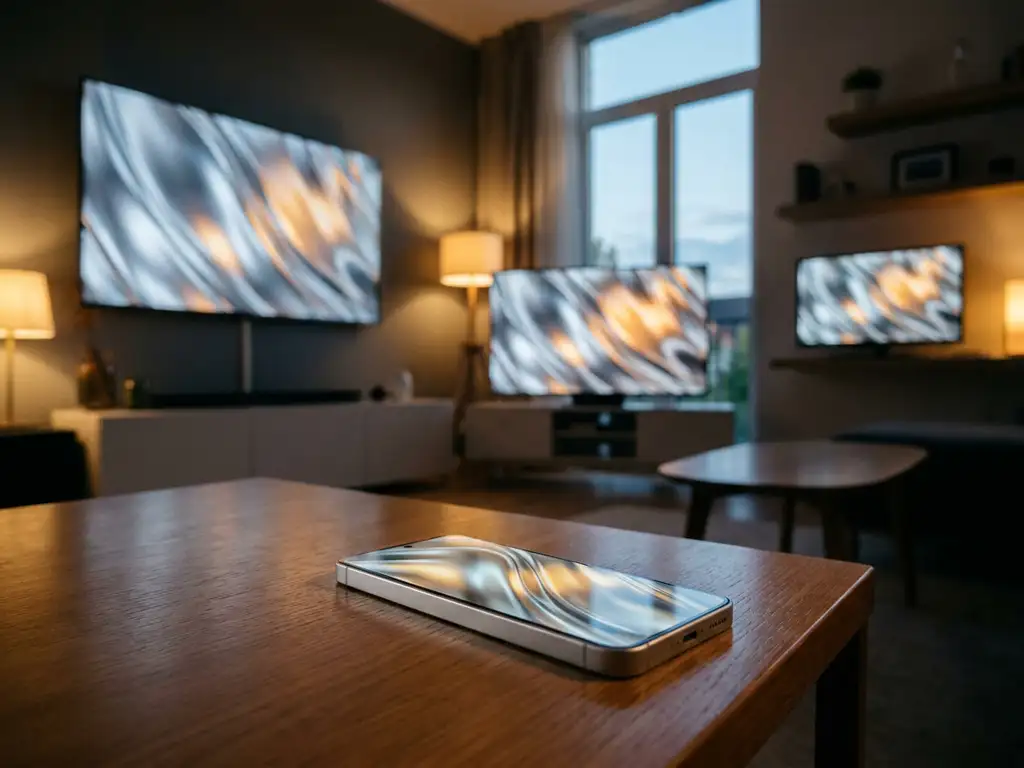
No, most universal TV remote apps cannot send commands to two or more TVs at exactly the same time. They are designed to connect to one TV per session. However, nearly all of them let you save multiple TVs in the app and switch between them with a tap, which takes only a few seconds. For most households, this is more than enough.
Think of it like having multiple profiles saved in an app. You are not logged into all of them at once, but switching between them is instant. If you want to turn off the TV in the living room and then switch to the bedroom TV, you can do that from the same app without any extra setup.
True simultaneous control, where one button press affects every TV in the house at once, is a feature more commonly found in professional AV systems or smart home platforms like Google Home or Amazon Alexa. These platforms can group devices together and send broadcast commands, but they work differently from a standard remote app.
What are the limitations of controlling multiple TVs with one app?
The main limitation is that you can only actively control one TV at a time. Beyond that, there are a few other practical constraints worth knowing about before you rely on a remote app across multiple rooms.
- Same Wi-Fi network required: All your TVs need to be connected to the same network your phone is on. If a TV in a back room is on a guest network or a different band, the app may not detect it.
- Brand compatibility: Some apps work better with specific brands. A universal app might support Samsung and LG flawlessly but have limited functionality with an older Panasonic model.
- No group commands: You cannot press mute once and silence every TV in the house. Each TV needs its own command, even if switching between them is fast.
- App stability: Remote apps depend on a stable Wi-Fi connection. If your network drops or a TV goes into sleep mode, you may need to reconnect.
- Streaming device differences: Controlling a Roku or Amazon Fire TV through a remote app may work slightly differently than controlling a smart TV directly, since they use different communication protocols.
None of these limitations are dealbreakers for everyday use, but they are worth factoring in if you are managing a larger home with several screens.
Which apps support multi-TV control the best?
The best apps for managing multiple TVs are the ones that make switching between saved devices fast and intuitive. Apps that store your TV profiles and reconnect automatically are the most practical for multi-room households.
When evaluating remote apps for multi-TV use, look for these features:
- The ability to save multiple TV profiles in the app
- Fast switching between devices without re-entering setup
- Broad brand compatibility so all your TVs are supported
- Support for streaming devices like Roku and Fire TV alongside smart TVs
- A clean, simple interface that makes it obvious which TV you are currently controlling
Apps that support a wide range of brands, including Samsung, LG, TCL, Sony, and Roku, tend to be the most flexible in mixed-device households. Haptic feedback is also a small but useful feature, since it confirms your tap registered without you having to look up at the screen.
Should you use a remote app or a screen mirroring app instead?
It depends on what you are actually trying to do. A remote app replaces your physical TV remote. A screen mirroring app puts your phone or laptop screen onto the TV. They solve different problems, and in some cases, you might want both.
Use a universal TV remote app when you want to:
- Control your TV without hunting for the physical remote
- Switch inputs or adjust volume from across the room
- Manage multiple TVs from one device
Use a screen mirroring app when you want to:
- Show your phone screen, photos, or videos on a bigger TV
- Stream content from your iPhone, iPad, Mac, or Android device to your TV
- Present slides or documents from your laptop on a TV in a meeting room
If you are watching a video on your phone and want it on the big screen, a remote app will not help with that. You need screen mirroring for that job. But if your remote is lost and you just want to change the channel, a remote app is exactly what you need.
How AirBeamTV Helps with TV Remote and Screen Mirroring Control
We built our Universal TV Remote App to make managing your TVs as simple as possible, whether you have one screen or several. Here is what you get:
- Multi-TV support: Save all your TVs in the app and switch between them instantly, with no re-setup needed each time
- Wide brand compatibility: Works with Samsung, LG, TCL, Sony, Roku, Amazon Fire TV, and more
- Full remote functions: Volume, channel switching, source selection, mute, touchpad, and keyboard input, all in one place
- No extra hardware: Just connect your phone and TV to the same Wi-Fi network and you are ready to go
- Haptic feedback: Every tap confirms instantly, so you always know your command went through
And if you want to go beyond remote control and actually mirror your phone, iPad, or Mac screen to your TV, we have screen mirroring apps for that too. No Apple TV, cables, or extra hardware required.
Download the Universal TV Remote App, open it, select your TV, and start controlling. It really is that straightforward.